Norway's New Government Quarter
Designing for democracy: SLA's public realm repairs and reopens Oslo's central government quarter for all.

Curious for more?
Louise Fiil Hansen
Design Director, Partner, Urban Designer
Location
Oslo, Norway
Size
182,000 m2
Year
2014 — 2026
Client
Statsbygg
Partners & Collaborators
Team Urbis: Nordic, Rambøll, Bjørbekk & Lindheim, Asplan Viak, COWI.
After twelve years of planning, public consultations, design and construction, the first phase of Norway’s New Government Quarter (Regjeringskvartalet) in Oslo has been opened to the public – on the site of the 22 July 2011 terrorist attack, which traumatised Norway.
For SLA, the opening marks the culmination of twelve years of work developing the public realm – from the earliest strategic framework plans to the design of streets, squares, parks and civic spaces that now welcome ministers, civil servants, visitors and the people of Norway back into the heart of Oslo.
Rather than becoming a closed governmental enclave, the New Government Quarter is designed as an integral part of the city’s everyday life: a place where democracy is experienced not only inside government buildings but also through public space.


A landscape designed for democracy
The terrorist attack of 22 July fundamentally changed the conversation around security and public institutions across Europe. For SLA, the planning challenges became not simply how to make a government district secure, but how to ensure that security would strengthen – not diminish – the democratic relationship between state and society.
The public realm has therefore been conceived as an urban landscape where openness, accessibility and trust form the foundation of security.
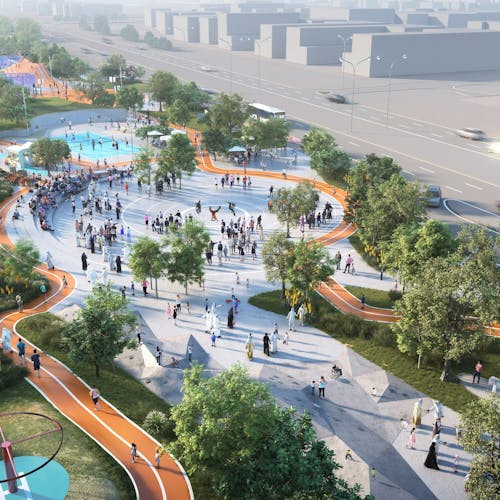
The public realm design – delivered in a close collaboration with fellow landscape architects Bjørbekk & Lindheim – introduces a coherent sequence of streets, plazas and green spaces that transform what was once a disconnected governmental district into a walkable civic neighbourhood.
By reopening historic connections, introducing new pedestrian routes and creating generous public spaces, the project repairs decades of fragmentation while reconnecting the Government Quarter with Oslo’s surrounding neighbourhoods, the city centre and the wider urban fabric.
“Today, many government districts around the world are becoming increasingly isolated from the cities they serve. In Oslo, we wanted to demonstrate another possibility – that security and openness are not opposites, but can reinforce one another through thoughtful urban design.”
— Louise Fiil Hansen. Partner and Design Director, SLA


Open, yet secure
A defining ambition has been to replace visible fortification with integrated urban design, creating a secure yet open and inviting Government Quarter for all. All of the project’s security measures are embedded directly within the landscape, creating protection without a sense of barriers.
In addition to integrated safety, the project’s city nature design also acts as essential civic infrastructure.
Trees, planting, rainwater management, water features, and locally adapted vegetation create healthier microclimates while strengthening local biodiversity and improving resilience to future climate conditions. Central to the planning of the new Government Quarter is also the creation of central Oslo’s first new public park in a generation that will add much-needed greenery and recreation to the centre of Oslo.
Trees, planting, topography, paving and water are doing far more than creating beautiful spaces – they organise movement, shape identity, improve climate resilience and support local biodiversity while creating places where people genuinely want to spend time.
“All of the project's security measures are embedded directly within the landscape, creating protection without a sense of barriers. Now people are sitting up against the government buildings while eating their lunch – which is all the more amazing given that the very same buildings so recently were the victims of a horrendous terror attack.”
— E.C. Forfang, Lead Designer and Associate Partner, SLA


Art woven into the public realm
The new public spaces of the New Government Quarter are also home to some of Norway’s most significant contemporary public artworks, making art an integral part of the civic landscape. Commissioned and developed by KORO – Public Art Norway, landscape architecture, public realm, and art together create spaces for everyday life, collective memory and national identity.
At Johan Nygaardsvolds plass, artist Jumana Manna’s artwork Sebastia creates a 800-square-metre “city floor” mosaic, composed of stone offcuts donated by municipalities from across Norway, embeding pieces of the entire country into the democratic heart of the capital.
At Einar Gerhardsens plass, Do Ho Suh’s Grass Roots Square has been carefully integrated into the landscape as a field of almost 50,000 small bronze figures supporting large stone slabs, creating a powerful metaphor for democracy itself.
Completing the sequence of civic spaces is Matias Faldbakken’s Upholding, Norway’s National 22 July Memorial, located in the central square of the restructured Government Quarter.


A new civic heart for Oslo
The completion of the New Government Quarter represents more than the delivery of a landscape project.
It demonstrates how landscape architecture can address some of the defining questions facing contemporary cities: How do we rebuild trust after trauma? How do we create secure public institutions without separating them from society? And how can nature and public space strengthen democracy itself?
“When Norway asked itself how a democracy should rebuild after 22 July, the answer could easily have been higher walls and greater distance between government and society. Instead, our ambition was to respond with greater openness, stronger democratic values and smarter, integrated security. Not by being naïve about the threats we face, but by refusing to let fear define the spaces where democracy lives. We hope this project shows that nature can help make that possible – in the streets, squares and parkland at the heart of Norway's democracy.”
— Louise Fiil Hansen, Partner and Design Director, SLA