Nordborg Resort
A nature-rich holiday resort where tourism gives back to the landscape.

Location
Als, Denmark
Size
190 hectares
Year
2019 — 2025
Client
Bitten & Mads Clausens Fond, Linak Holding, Center Parcs Nordborg Resort A/S
Role
Lead Landscape Architect
Partners & Collaborators
ZENI arkitekter, Hoffmann, Rambøll, VITA ingeniører
Challenges
Services
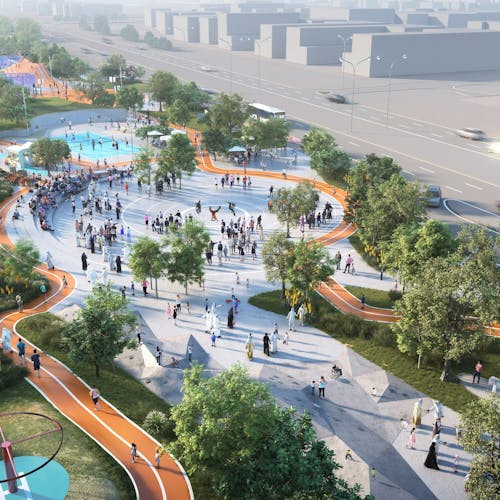
On the coast of Nordals, overlooking Lillebælt, a new kind of holiday destination has taken shape. Nordborg Resort combines 440 holiday homes, a waterpark, restaurants, activities and Denmark’s longest beach promenade with 190 hectares of landscape designed around the existing character and ecology of Als.
Designed by SLA, the master plan and nature landscape make nature more than a setting for the resort. Large ecological corridors have been left untouched, while more than 4,000 new trees have been planted and 20 hectares of forest restored. New habitats, water bodies and connections across the landscape strengthen biodiversity and allow wildlife to move through the site.
The result is a resort where buildings and holiday experiences are embedded in a diverse landscape – and where the landscape itself becomes one of the project’s main attractions.


Designing with nature, not against it
From the outset, the ambition was to create a holiday destination that could combine tourism, local development and nature restoration. Rather than treating the 190-hectare site as a blank canvas, the landscape design works with its existing nature and local landscape typologies.
Large areas of the site remain open and undeveloped, creating ecological corridors through the resort. New woodland expands the existing landscape, while more than 4,000 trees contribute to a richer and more varied habitat structure.
Water is another important part of the ecological strategy. New ponds and water habitats have been established to support biodiversity, including ponds developed in collaboration with the Danish Society for Nature Conservation (Danmarks Naturfredningsforening) to benefit endangered species. Rainwater is collected and managed through the landscape, including rainwater basins and the resort’s lake. A wildlife corridor further connects habitats across the site.
Together, these interventions turn the landscape into functioning infrastructure for both people and other species.


A DGNB Gold-transformation at landscape scale
The ambition is reflected in the project’s DGNB Gold certification. Nordborg Resort became the first holiday resort in Europe to achieve the certification, which assesses environmental, social and economic aspects across the project.
The certification recognises, among other things, the project’s approach to biodiversity, water management, energy, materials and social considerations.


Nature as a driver for local development
The resort is conceived not only as a destination in Nordborg, but as a catalyst for the surrounding community.
Since opening, the local businesses on Als have reported increased activity. Shops in Nordborg have experienced busier summers, with local retailers reporting increased turnover and hiring additional seasonal staff. Local businesses and landlords have also reported increased activity linked to the influx of resort guests.
The resort itself has also become a significant local workplace. By summer 2026, Nordborg Resort had 156 employees registered, equivalent to 95 full-time positions.
The landscape is part of this local connection too. Parts of the resort are accessible to local residents, with the pier, paths and landscape offering new places to walk and experience the coast. Local kindergartens, for example, use the site and its visitor farm and play areas.
In this way, the project extends beyond the boundaries of the resort itself. Nature, tourism and local life become interconnected – creating value not only for visitors, but for the wider Nordborg community.


A new model for nature-based tourism
Nordborg Resort demonstrates how a large tourism development can be planned as part of a living landscape rather than simply placed within one.
By protecting ecological corridors, restoring forests, creating new habitats and managing water as part of the landscape, the project gives nature an active role in shaping the resort. At the same time, the landscape creates the setting for meaningful holiday experiences: walking, playing, exploring, meeting and spending time outdoors.
The result is a place where tourism and nature are not opposing forces but can reinforce one another – and where the investments in nature and landscape create environmental, social and economic value at the same time.